
The impact international students have on higher education in the U.S.
By: Christie Yeung
April 24, 2025
Story highlights
- Three months into his second term as President of the United States, Donald Trump has signed more than 120 Executive Orders, including immigration policy changes that could impact international students’ legal status.
- Given the travel ban against certain predominantly Muslim countries in Trump’s first term, universities around the country share concerns regarding international students’ ability to return to the U.S. from traveling out of the country.
- “We’re in San Diego, so I often travel down to Tijuana and back to San Diego for the weekend trip but because of the current situation, I’m not really comfortable to travel down there anymore,” My Thu, a San Diego State third-year graduate student majoring in geography and holder of F-1 visa, said.
SAN DIEGO – Since Donald Trump was inaugurated in January, he has signed more than 120 Executive Orders. One of which is called “Protecting the American People Against Invasion,” and it enables Homeland Security personnel to arrest and remove illegal aliens in the United States.
This order stated that aliens should be removed because some threatened public safety and national security by “committing vile and heinous acts against innocent Americans,” while others engaged in hostile activities, including espionage, economic espionage, and preparations for terror-related activities.”
Trump’s vision to remove threats was successful because on Feb. 26, Secretary of Homeland Security, Kristi Noem, released an announcement that stated more than 20,000 illegal aliens were arrested “in a single month under President Trump.”
However, this Executive Order impacts not only anyone under ‘illegal’ status but also international students and anyone staying in the United States with a visa.
Why international students’ voices matter
According to Open Doors, a report that collects information on international students in the U.S, and is sponsored by the U.S. Department of State with funding provided by the U.S. Government and supported in its implementation by IIE, stated that a record-high 1.1 million international students studying in the United States during the 2023-24 academic year.
The total number of international students has been increasing since the end of the COVID-19 pandemic, from 948,519 in 2021-2022 to over 1.1 million in 2023-2024.
The percentage of international students has been increasing, from 4.7% to 5.9%, since 2021-22.
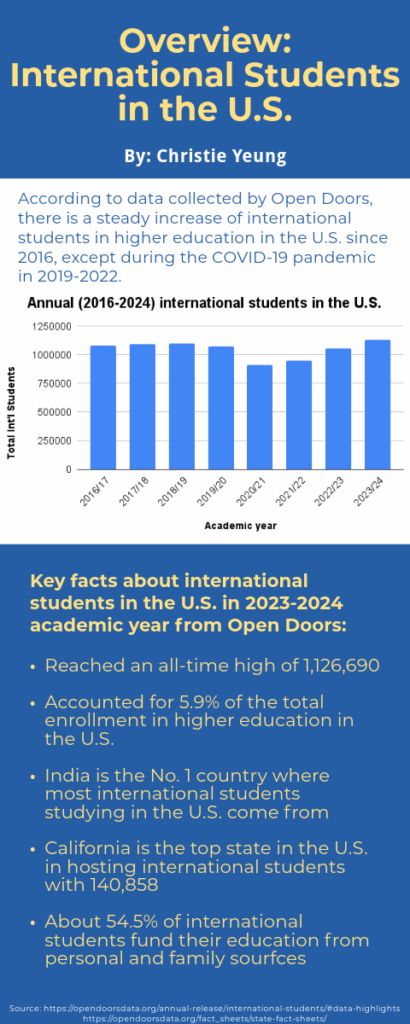
However, the data also shows that during Trump’s first term, 2017 to 2021, that growth was in decline which may repeat in his second term based on the immigration policy changes in a series of Executive Orders.
But why does it matter?
The National Association of Foreign Student Advisers (NAFSA), an organization that advocates international education and policy to better global citizenship, shared that the 1.1 million international students “contributed $43.8 billion to the U.S. economy” and “supported more than 378,000 jobs” during the 2023-24 academic year.
According to data collected by NAFSA and JB International on international students’ contribution to the U.S. economy, San Diego State University is ranked No. 13 in California.
SDSU international students contributed $83.9 million along with 635 jobs during the 2023-2024 academic year.
Based on an SDSU estimated standard of cost for an undergraduate non-resident in a nine-month academic year in 2024-25, it ranged from $47,322 to $50,690, living on or off-campus.
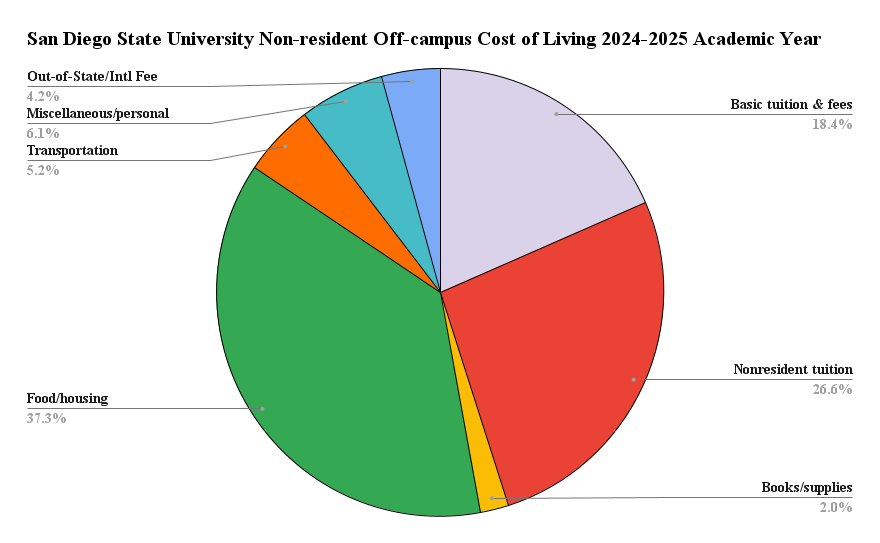
Based on the lower amount of $47,322, base tuition and fees would cost $8,728 but international students would pay an extra $12,600 – for a 15-unit semester and $444 per unit – being non-residents. Those tuition combined, $21,328, is almost half of the cost of living off-campus in San Diego.
There were 957 non-resident international students enrolled in SDSU in the fall of 2024, which means there was at least $45 million floating into the economy, if they enrolled in the full academic year.
If the immigration policy changes lead to a decline in international student enrollment, it would impact the economy negatively.
According to Open Doors, California is the No. 1 in housing international students with over 140,858 students during the 2023-2024 academic year and it was estimated that these students would have contributed over $6.4 billion to the economy.
Raising concerns among institutes
Matt Lavietes of NBC reported that students from Cornell University, Columbia University and Georgetown University, along with a professor from Brown University, were either detained, deported or had their visas revoked when these visa holders, for various reasons of demonstrating their support for Palestinians by attending an Iran-backed leader’s funeral.
International students who expressed their political views were being put under scrutiny, especially if they participated in protests, according to CNN reporters Rafael Romo, Nick Valencia and Chris Youd, stated there was no official reason why those students’ visas were revoked, but the Secretary of State Macro Rubio said that participating in protests is not tolerable behavior.
A data report by U.S. News showed international student enrollment rates among U.S. colleges and universities in fall 2023, 16 of which with over 20% and 97 had between 10% to 19%.
If international student enrollment led to a decline due to student visa revocation or rejection, colleges and universities, particularly those with a high international student enrollment rate, could be left with a void to fill.
Wary on the local level
SDSU international students share mixed feelings about being informed and feeling safe about traveling.
Sarina, an international student on a J-1 visa, said that she does not feel comfortable traveling in and out of the country despite not having any plans to travel while studying.
“I didn’t really feel comfortable traveling in and out just because,” Sarina said. “I wouldn’t want to have any issues with coming back into the US.”
Sarina also said that she had not heard much about this immigration policy from the school.
“Personally, I don’t know if that’s just because I haven’t been really checking my emails or anything but I genuinely haven’t heard much from the school about immigration policies at all,” Sarina said.
Another international student, Yu, who is also on a J-1 visa, also mentioned that she didn’t feel very informed about this immigration policy change
Yu said that she had received an email from the school related to the immigration policy changes, however, it was not enough to explain the situation.
The Office of the President of SDSU shared a statement on April 11, stating that four SDSU students on F-1 visas had had their visas revoked.
Followed by an updated statement by California State University that stated, “As of April 15, 2025, a total of 70 CSU students have been impacted by visa revocations since the start of the year.”
Then on April 17, Annie Ma, Makiya Seminera and Christopher L. Keller of the Associated Press reported that since late March, there were over 1,024 students from 160 colleges, universities and university systems either had their visas revoked or their legal status terminated.
Tension continues to rise as more international students’ visas are being revoked. The future remains unclear whether foreign students will select the U.S. for higher education.
The reporter tried to contact the International Student Center on campus for comment but was unsuccessful.